বৃত্তের সমীকরণ ও পোলার সমীকরণ সংক্রান্ত
\(2r \sin^2 \frac{\theta}{2} = 1\) সমীকরণটির কার্তেসীয় আকার -
\(x^2 = 1 - 2y\)
\(y^2 = 1 + 2x\)
\(y^2 = 1 - 2x\)
\(x^2 = 1 + 2y\)
x২ + y২ - ৯x = ০ বৃত্তটির পোলার সমীকরণ-
\( \mathrm{r}=9 \cos \theta \)
\( \mathrm{r}=3 \cos \theta \)
\( r+9 \cos \theta=0 \)
\( r+3 \cos \theta=0 \)
\( \mathbf{r}=\mathbf{a} \sin \theta \) সমীকরণটি নির্দেশ করে-
বৃত্ত
পরাবৃত্ত
উপবৃত্ত
অধিবৃত্ত
বিন্দু বৃত্তের সমীকরণ০
\({x}^{2}+y^{2}=r^{2} \)
\( x^{2}-y^{2}=0 \)
\( x^{2}+y^{2}=0 \)
\( x^{2}+y^{2}=1 \)
x² + y² = α(x + α) বৃত্তের ব্যাসার্ধ কত?
\( \sqrt{\frac{2\alpha}{3}} \)
\( \sqrt{\frac{\alpha}{2}} \)
\( \sqrt{\frac{5}{2}} \)
\( \frac{\sqrt{5}}{2} \alpha \)
\( 2x^2 + 2y^2 - 3x + y - 1 = 0 \) বৃত্তের কেন্দ্র কত?
\( (\frac{3}{4}, -\frac{1}{4}) \)
\( (\frac{3}{4}, 1) \)
\( (-\frac{3}{4}, 1) \)
\( (-\frac{3}{4}, -1) \)
\(x^2 + y^2 + 14x + 2y + 34 = 0\) বৃত্তের কেন্দ্র ও ব্যাসার্ধ কোনটি?
\((-7, -1)\) এবং ৪
\( (7, -1)\) এবং ৪
\((-7, -2)\) এবং ৪
\( (7, 1)\) এবং ৪
২x² + ২y² – ৩x + ৪y = ০ বৃত্তের কেন্দ্র কত?
\( \left(\frac{3}{4}, -1\right) \)
\( \left(\frac{3}{4}, 1\right) \)
\( \left(-\frac{3}{4}, 1\right) \)
\( \left(-\frac{3}{4}, -1\right) \)
\( x^2 + y^2 - 8x + 10y + 5 = 0 \) বৃত্তের ব্যাসার্ধ কত?
৮
৬
৪
৭
\( (2, -3) \) বিন্দুটি \( x^2 + y^2 - 6x - y + 2 = 0 \) বৃত্তের-
ভিতরে
বাহিরে
উপরে
নিম্নস্থলে
\( x^2 + y^2 - 6x - 8y - 75 = 0 \) বৃত্তের ব্যাসার্ধ কত?
৩
৭
৯
১০
বৃত্তের কেন্দ্রের সঞ্চারপথ নির্ণয় কর যেন তাদের জ্যা \(5x + 2y = 16\) এর মধ্যবিন্দু \((2, 3)\) হয়।
\(2x - 5y = 11\)
\(2x + 5y - 11 = 0\)
\(2x + 5y + 11 = 0\)
\(2x - 5y + 11 = 0\)
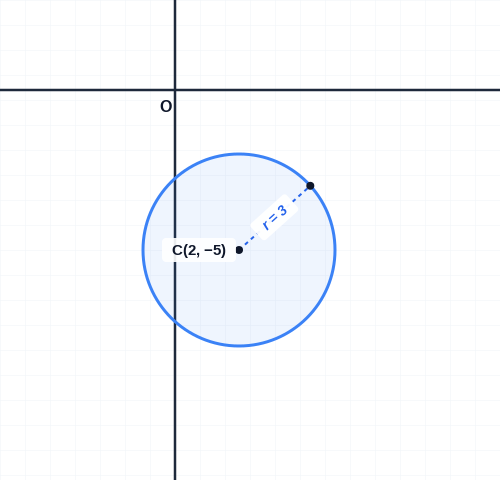 চিত্রের বৃত্তের সমীকরণ কোনটি?
\(x^2 + y^2 - 8x - 10y + 16 = 0\)
\(x^2 + y^2 + 8x - 10y + 16 = 0\)
\(x^2 + y^2 + 8x - 10y - 16 = 0\)
\(x^2 + y^2 - 4x + 10y + 11 = 0\)
\(x^2 + y^2 - 6x - 10y + 21 = 0\) বৃত্তের উপর \((1, 2)\) বিন্দুতে অঙ্কিত স্পর্শকের সমীকরণ কোনটি?
\(2x + 3y - 8 = 0\)
\(2x + 3y + 8 = 0\)
\(2x + y - 8 = 0\)
\(x + 3y - 8 = 0\)
x২+y২=১৪৪ বৃত্তের জ্যা এর সমীকরণ যার মধ্য বিন্দু (৪,-৬) বিন্দুতে অবস্থিত-
২x-৩y=২৬
২x+৩y=৫
৩x-২y=২৬
৩x+২y=৫
ax২ + by২ = c সমীকরণটি একটি বৃত্ত নির্দেশ করে যদি-
a≠b
a/b=২
a/b=১
both B & C
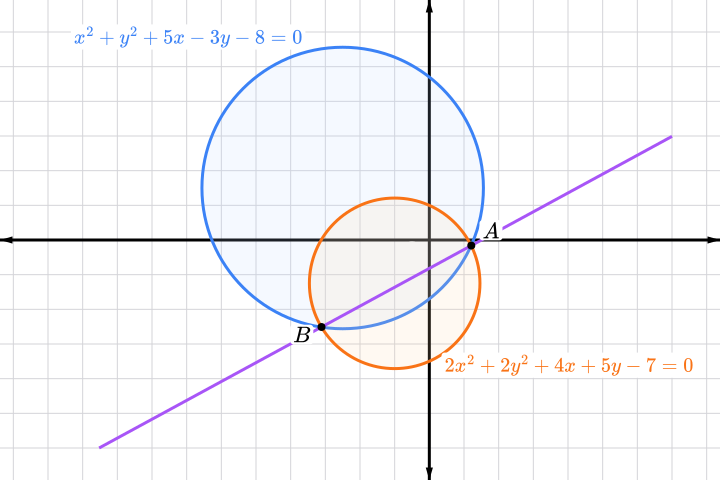
\( x^{2}+y^{2}+5 x-3 y-8=0 \text { ও } 2 x^{2}+2 y^{2}+ \) ৪x +৫y - \( 7=0 \) বৃত্তদ্বয়ের সাধারণ জ্যা এর সমীকরণ কোনটি?
\( x^{2}+y^{2}-x+8 y+15=0 \)
\( 7 x-y-5=0 \)
\( 6 x-11 y-9=0 \)
\( 3 x-11 y+9=0 \)
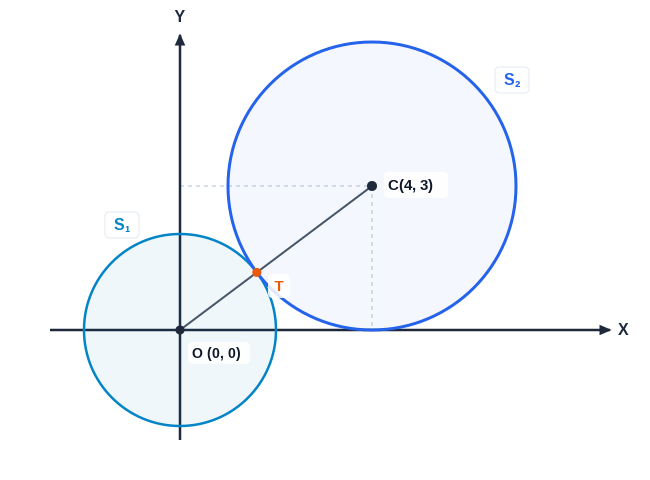
OT=২ হলে, S২ বৃত্তটির সমীকরণ কী হবে?
x২+y২-৮x-৬y+১৬=০
x২+y২=৯
x২+y২-৮x-৫y+১৬=০
x২+y২=০
Consider the equation of a circle given by \( (x-5)^2 + (y-1)^2 = 25 \). Which of the following two straight lines are the tangent lines of the above circle? (i) \( y - 4 = \frac{4}{3} (x-1) \) (ii) \( y - 5 = \frac{3}{4} (x-8) \)
Both (i) and (ii)
Only (i)
Only (ii)
Neither (i) nor (ii)
The centre of a circle is \((-6,4)\). If one end of the diameter of the circle is at \((-12,8)\), then the other end is at
\((-18,12)\)
\((-9,6)\)
\((-3,2)\)
\((0,0)\)
The equation of the tangent line(s) of the circle \( (x-2)^{2}+(y+3)^{2}=160 \) is/are-
\( y+15=\frac{1}{3}(x-6) \)
\( y-9=\frac{1}{3}(x+2) \)
Both (a) and (b)
None of (a) and (b)