সৃজনশীল প্রশ্ন
\( f(x)=\sin x \) এবং \( g(y)=\cos y \)
\( \sin ^{-1} \frac{4}{5}+\cos ^{-1} \frac{2}{\sqrt{5}} \) এর মান নির্ণয় কর।
\( f(x)+g\left(\frac{\pi}{2}-2 x\right)+f(3 x)=1+g(x)+f\left(\frac{\pi}{2}-2 x\right) \) সমীকরণটির সমাধান কর।
প্রমাণ কর যে, \( 2 \tan ^{-1} \frac{f\left(\frac{\alpha}{2}\right)}{f\left(\frac{\pi}{2}-\frac{\alpha}{2}\right)} \tan \left(\frac{\pi}{4}-\frac{\beta}{2}\right) \) \( =\tan ^{-1} \frac{f(\alpha) \cdot g(\beta)}{f\left(\frac{\pi}{2}-\beta\right)+f\left(\frac{\pi}{2}-\alpha\right)} \)
null
দৃশ্যকল্প-১: \( l=2 \sin ^{-1}\left(\frac{1}{\sqrt{5}}\right)+\sec ^{-1}\left(\frac{5}{4}\right) \).
দৃশ্যকল্প \( \mathrm{F}: f(x)=\cot ^{-1} \frac{1}{x} \).
\( \cos ^{-1} \sin \cos ^{-1}\left(\frac{1}{2}\right) \) এর মুখ্যমান নির্ণয় কর।
দৃশ্যকল্প-১ হতে দেখাও যে, \( L=\frac{\pi}{2} \).
দৃশ্যকল্প-২ হতে -\(\infty\) < x < \(\infty\) ব্যবধিতে y = \( \mathrm{} f(x) \) এর লেখচিত্র অঙ্কন কর।
\( f(x)=\cos x. \)
\( \sec ^{2}\left(\cot ^{-1} 2\right)-3 \sin ^{2}\left(\cos ^{-1} \frac{1}{2}\right) \) এর মান নির্ণয় কর।
সমাধান কর : \( \frac{f( x)+f(3 x)}{f(5 x)+f(7 x)}=-1 \).
সমাধান কর : \( \frac{f(\theta)}{1+f\left(\frac{\pi}{2}-\theta\right)}+\frac{f\left(\frac{\pi}{2}-\theta\right)}{f(\theta)}=\frac{2}{\sqrt{3}} \) যখন \( -\pi<\theta \leq \pi \).
\(\sin \mathrm{A}=\frac{2}{\sqrt{5}}, \cos \mathrm{B}=\frac{4}{5}, \cot \mathrm{C}=3\)
এবং \(\mathrm{g}(\theta)=\cos \theta-\cos 7 \theta\).
প্রমাণ কর যে, \(\sin \cdot \tan ^{-1} \cdot \cot \cdot \cos ^{-1} \mathrm{y}=\mathrm{y}\).
প্রমাণ কর যে, \(\mathrm{A}-\frac{1}{2} \mathrm{~B}+\mathrm{C}=\tan ^{-1} 2\).
যদি \(g(\theta)=\sin 4 \theta\) হয়, তাহলে \(\theta\) এর মান নির্ণয় কর।
উদ্দীপক-১: \( A=\cot ^{-1} 7, B=\cot ^{-1} 3, g(A)=\cos 2 A, h(B)=\sin 4 B. \)
উদ্দীপক-২: \( \mathbf{f}(\alpha)=\cos \alpha, \mathbf{g}(\alpha)=\sin 2 \alpha, h(\alpha)=\frac{1}{\sqrt{2}} .\)
\( \cos ^{-1} \tan \cot ^{-1} \sqrt{2} \) এর মুখ্যমান নির্ণয় কর।
উদ্দীপক-১ এ প্রমাণ কর যে, \( \mathrm{A}=\mathrm{g}^{-1}\{\mathrm{~h}(\mathrm{~B})\} \).
উদ্দীপক-২ এর আলোকে সমাধান কর:
\( f(\alpha)+g\left(\frac{\alpha}{2}\right)=h(\alpha), \text { যখন }-2 \pi \leq \alpha \leq 2 \pi \)
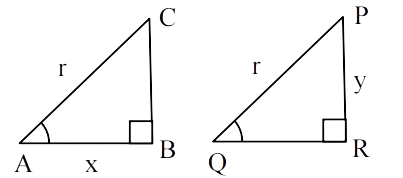
দেখাও যে, \( \cos \left(2 \tan ^{-1} \frac{y}{x}\right)=\frac{x^{2}-y^{2}}{x^{2}+y^{2}} \)
উদ্দীপকে A+P = \( \varphi \) হলে প্রমাণ কর যে, \( x^{2}-2 x y \cos \varphi+y^{2}=r^{2} \sin ^{2} \varphi \)
\( f(\theta)=\frac{r}{x} \text { হলে }-\pi \leq x \leq \pi \text { ব্যবধিতে } f(2 \theta)-f(\theta)=2 \) সমীকরণটি সমাধান কর।
\(f(x) = \tan^{-1} x, g(x) = \cos^{-1} x\)
প্রমাণ করো যে, \(\sin \cot^{-1} \tan \cos^{-1} x = x\)
\(g\left(\frac{x}{a}\right) + g\left(\frac{y}{b}\right) = \theta\) হলে, প্রমাণ কর যে, \(\frac{x^2}{a^2} - \frac{2xy \cos \theta}{ab} + \frac{y^2}{b^2} = (\sin \theta)^2\)
প্রমাণ করো যে, \(2f\left(\sqrt{\frac{a-b}{a+b}} \tan \frac{x}{2}\right) = \cos^{-1}\left(\frac{b + a \cos x}{a + b \cos x}\right)\)
\(g(x) = \cos x, \frac{\pi}{4} - \frac{3}{2} = x\)
দেখাও যে, \(\cos^{-1} \frac{1}{\sqrt{5}} - \frac{1}{2} \sin^{-1} \frac{3}{5} + \tan^{-1} \frac{1}{3} = \tan^{-1} 2\).
সমাধান কর: \(2 \tan^{-1} \{ \tan \frac{\alpha}{2} \tan x \} = \tan^{-1} \frac{\sin \alpha \cos \beta}{\sin \beta + \cos \alpha}\).
সমাধান কর: \(4g(x).g(2x).g(3x) = 1\), যেখানে \(0^\circ < x < \pi\).
\( p(x) = \sin x, q(x) = \cos x \)
\( q(2\tan^{-1} \frac{1}{7}) \) এর মান নির্ণয় কর।
\( p(\pi\cos\beta) = q(\pi\sin\beta) \) হলে দেখাও যে, \( \beta = \pm \frac{\pi}{4} + \sec^{-1} 2\sqrt{2} \)
সমাধান কর: \( p\left(\frac{\pi}{2} + \theta\right) - p\left(\frac{\pi}{2} - 7\theta\right) = q\left(\frac{\pi}{2} - 4\theta\right) \)
\(P = \cos^{-1}\left(\frac{1}{\sqrt{5}}\right), Q = \sin^{-1}\left(\frac{3}{5}\right), R = \tan^{-1}\left(\frac{1}{3}\right)\) এবং \(f(x) = \sin x\)
প্রমাণ কর যে, \(\sin \cot^{-1} \tan \cos^{-1} x = x\)
প্রমাণ কর যে, \(P - \frac{1}{2}Q + R = \tan^{-1} 2\)
সমাধান কর: \(f\left(\frac{\pi}{2} - x\right) + f(x) = \sqrt{2}\); যেখানে \(0 < x < 2\pi\)
একটি কোণ \(y = \cos^{-1}\left(\frac{m}{n}\right)\); যেখানে \(m, n\) ধ্রুবক এবং \(f(z) = 4\cos z \cdot \cos 2z \cdot \cos 3z\)
\(\cos^{-1}(\sqrt{2}\sin\theta) + \cos^{-1}(\sqrt{\cos 2\theta})\) এর মান বের কর।
দেখাও যে, \(\text{cosec}^{-1}\frac{5}{3} + \frac{1}{2}y - \cot^{-1}2 = \cot^{-1}\frac{29}{28}\) যেখানে, \(m=5, n=13\)
\(0 < z < \pi\) ব্যবধিতে \(f(z) = 1\) এর সমাধান বের কর।
\( f(x)=\cos ^{-1} x \text { এবং } g(x)=\sin x \)
\( 2 \tan ^{-1} x=\sin ^{-1} \frac{2 a}{1+a^{2}}+\cos ^{-1} \frac{1-b^{2}}{1+b^{2}} \) হলে, দেখাও যে, \( x=\frac{ {a}+\mathrm{b}}{1-\mathrm{ab}} \)
সমাধান কর: \( 4 g\left(\frac{\pi}{2}-x\right) g\left(\frac{\pi}{2}-2 x\right) g\left(\frac{\pi}{2}-3 x\right)=1 \) যদি \( 0<x<\pi\)
\( \mathrm{f}(\mathrm{x})+\mathrm{f}\left(\frac{\mathrm{m}}{\mathrm{y}}\right)=\theta \) হলে দেখাও যে, \( \mathrm{x}^{2}+\frac{\mathrm{m}^{2}}{\mathrm{y}^{2}}-\frac{2 \mathrm{mx} \cos \theta}{\mathrm{y}}=\sin ^{2} \theta \)
\( \begin{array}{l} \mathbf{R}=2 \tan ^{-1}\left(\sqrt{\frac{m}{n}} \tan \frac{\theta}{2}\right), Q=\sin ^{-1} \frac{2 \sqrt{m n} \sin \theta}{(n+m)+(n-m) \cos \theta} \text { এবং } \\ \mathbf{R}=\sin ^{-1} \frac{3}{5}+\frac{1}{2} \cos ^{-1} \frac{5}{13}-\cot ^{-1} 2 \end{array} \)
প্রমাণ কর যে, \( \sin ^{-1} \frac{1}{3}+\cos ^{-1} \sqrt{\frac{2}{3}}=\tan ^{-1} \sqrt{2} \)
দেখাও যে, \( P=Q \)
প্রমাণ কর যে, \( \mathrm{R}=\tan ^{-1} \frac{28}{29} \)
(i) \( A=\operatorname{cosec} \theta+\cot \theta \)
(ii) \( \mathrm{B}=\tan ^{-1} \mathrm{x}+\frac{1}{2} \sec ^{-1} \frac{1+\mathrm{y}^{2}}{1-\mathrm{y}^{2}}+\frac{1}{2} \operatorname{cosec}^{-1} \frac{1+\mathrm{z}^{2}}{2 \mathrm{z}} \)
\( \frac{1}{2} \sin ^{-1} \frac{3}{5}-\tan ^{-1} \frac{1}{3} \) এর মান নির্ণয় কর।
\( \mathrm{B}=\pi \) হলে প্রমাণ কর যে, \( \mathrm{x}+\mathrm{y}+\mathrm{z}=\mathrm{xyz} \).
\( A=\sqrt{3} \) হলে সমীকরণটি সমাধান কর (যখন \( -\pi<\theta<\pi \) )
\( \cos \beta-\cos 9 \beta=\sin 5 \beta \) এবং \( f(x)=\cot ^{-1} y-\tan ^{-1} x \)
প্রমাণ কর যে, \( 2 \tan ^{-1}\left\{\sqrt{\frac{a-b}{a+b}} \cdot \tan \frac{\theta}{2}\right\}=\cos ^{-1} \frac{b+a \cos \theta}{a+b \cos \theta} \)
\( f(\mathrm{x})=\frac{\pi}{6} \) হলে দেখাও যে, \( \mathrm{x}+\mathrm{y}+\sqrt{3} \mathrm{xy}=\sqrt{3} \)
\( \beta \) এর সাধারণ মান নির্ণয় কর।
\( f(x)=\sin \left(\frac{\pi}{2}-x\right) \)
প্রমাণ কর যে, \( \frac{1}{2} \sin ^{-1} x=\tan ^{-1} \frac{1-\sqrt{1-x^{2}}}{x} \)
সমাধান কর: \( f(\theta) . f(2 \theta) \cdot f(3 \theta)=\frac{1}{4} \) যখন,\( \pi \leq \theta \leq \pi \)
\( \mathrm{f}(\pi \sin \theta)=\sin \{\pi \mathrm{f}(\theta)\} \) হলে দেখাও যে, \( \theta= \pm \frac{1}{2} \sin ^{-1} \frac{3}{4} \)
(i)
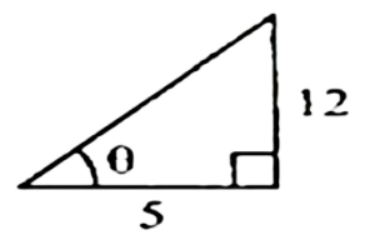 (ii) \( \sin (\pi \sin x)+\cos (\pi \cos x)=0 \)
দেখাও যে, \( \cos ^{-1} \sqrt{\frac{2}{3}}-\cos ^{-1} \frac{\sqrt{6}+1}{2 \sqrt{3}}=\frac{\pi}{6} \)
উদ্দীপক (i) অনুসারে দেখাও যে,
\( 2 \operatorname{cosec}^{-1} \frac{5}{3}+\theta-2 \cot ^{-1} \frac{29}{28}=2 \tan ^{-1} \frac{1}{2} \)
উদ্দীপক (ii) হতে দেখাও যে, \( x= \pm \frac{\pi}{4}+\operatorname{cosec}^{-1}(2 \sqrt{2}) \)
\( f(x)=\cos x ; P=\sin ^{-1} \frac{2}{\sqrt{5}}-\frac{1}{2} \sin ^{-1} \frac{3}{5}+\sin ^{-1} \frac{1}{\sqrt{10}} \)
\( \cos ^{-1} a+\cos ^{-1} b=\frac{\pi}{2} \) হলে প্রমাণ কর যে, \( a^{2}+b^{2}=1 \)
সমাধান কর: \( 1+f(2 x)+f(4 x)+f(6 x)=0 \)
দেখাও যে, \( \tan \mathrm{P}=2 \)
\( f(x)=\sin x, g(x)=x^{3}+p^{2}+q x+r \)
\( \sqrt[4]{-36} \) এর মান নির্ণয় কর।
\( f\left(\frac{\pi}{2}+x\right)+f(x)=f\left(\frac{5 \pi}{2}-2 x\right)+f(2 x) \) সমীকরণটি সমাধান কর যখন \( -2 \pi \leq x \leq 2 \pi \)
\( \mathrm{g}(\mathrm{x})=0 \) সমীকরণের মূলত্রয় \( \alpha, \beta, \gamma \) হলে \( \beta \gamma+\frac{1}{\alpha}, \gamma \alpha+\frac{1}{\beta} \), \( \alpha \beta+\frac{1}{\gamma} \) মূলবিশিষ্ট সমীকরণ নির্ণয় কর।
(i) \( \sin (\pi \cos \theta)=\cos (\pi \sin \theta) \)
(ii) \( x=\cos A, y=\cos B, z=\cos C \)
যদি \( \sin ^{-1} x+\sin ^{-1} y=\frac{\pi}{2} \) হয় তবে প্রমাণ কর যে, \( x^{2}+y^{2}=1 \)
(i) হতে দেখাও যে, \( \theta= \pm \frac{\pi}{4}+\tan ^{-1}(\sqrt{7}) \)
\( \mathrm{A}+\mathrm{B}+\mathrm{C}=\pi \) হলে, প্রমাণ কর যে, \( \mathrm{x}^{2}+\mathrm{y}^{2}+\mathrm{z}^{2}+2 \mathrm{xyz}=1 \)
\( \cos \theta=\frac{4}{5} \) এবং \( \cos \alpha=\frac{3}{\sqrt{10}} \)
\( f(x)=\cos x+\cos 3 x+\cos 5 x+\cos 7 x \)
\( \cot \cos ^{-1} \sin \tan ^{-1} \frac{4}{3} \) এর মান নির্ণয় কর।
প্রমাণ কর যে, \( \sec ^{-1} \sqrt{5}+\frac{1}{2} \theta-\alpha=\cot ^{-1} 1 / 2 \)
সমাধান কর: \( f(\mathrm{x})=0 \) যেখানে, \( \mathrm{x} \in[0, \pi] \)
\( \mathrm{h}(\mathrm{x})=\sin \mathrm{x} \) এবং \( l(\mathrm{x})=\sin ^{-1} \mathrm{x} \)
সমাধান কর: \( \tan x=\cot x \)
\( \sqrt{1-\{\mathrm{h}(\mathrm{x})\}^{2}}+\sqrt{3} \mathrm{~h}(\mathrm{x})=\sqrt{2} \) সমীকরণটি সমাধান কর। যেখানে \(-2\pi<x<2\pi\)
দেখাও যে, \( \cos ^{-1} \frac{1}{\sqrt{5}}+\tan ^{-1} \frac{1}{3}-\tan ^{-1} 2=\frac{1}{2} l\left(\frac{3}{5}\right) \).
\( \mathrm{f}(\mathrm{x})=\tan ^{-1} \mathrm{x} \) এবং \( \mathrm{g}(\theta)=\cos \theta-\cos 7 \theta \)
\( f(x)=\cos ^{-1} \theta \) হলে, \( \theta \) এর মান \( x \) এর মাধ্যদে প্রকাশ কর।
দেখাও যে, \( 2 f\left(\sqrt{\frac{a-b}{a+b}} \tan \frac{\theta}{2}\right)=\cos ^{-1}\left(\frac{b+a \cos \theta}{a+b \cos \theta}\right) \)
সমাধান কর: \( g(\theta)=\sin 4 \theta \)
\( f(A)=\cos A=\frac{1}{\sqrt{5}}, \sin 2 B=\frac{3}{5} ; \tan C=\frac{1}{3}, \cot D=\frac{1}{2} \)
\( \cot ^{-1} P+\cot ^{-1} Q=\frac{\pi}{2} \) হলে দেখাও যে, \( P Q=1 \)
প্রমাণ কর যে, A-B + C = D
সমাধান কর: \( f\left(\frac{\pi}{2}-\theta\right) f\left(\frac{\pi}{2}-3 \theta\right)=f\left(\frac{\pi}{3}\right) ; 0<\theta<2 \pi \)
দৃশ্যকল্প-১: \( \sec \alpha=\frac{\mathrm{p}}{\mathrm{x}}, \sec \beta=\frac{\mathrm{q}}{\mathrm{y}} \)
দৃশ্যকল্প-২: \( \mathrm{h}(\mathrm{x})=\tan ^{-1} \mathrm{x}, f(\mathrm{x})=\cos \mathrm{x} \)
\( \sec ^{2}\left(\cot ^{-1} 1\right)+\sin ^{2}\left(\cos ^{-1} \frac{1}{2}\right) \) এর মান নির্ণয় কর।
দৃশ্যকল্প-১-এ \( \alpha+\beta=\gamma \) হলে প্রমাণ কর যে, \( \frac{\mathrm{x}^{2}}{\mathrm{p}^{2}}+\frac{\mathrm{y}^{2}}{\mathrm{q}^{2}}-\frac{2 \mathrm{xy}}{\mathrm{pq}} \cos \gamma=\sin ^{2} \gamma \)
দৃশ্যকল্ল-২ এর আলোকে প্রমাণ কর যে,
\( 2 \mathrm{~h}\left(\frac{\sqrt{\mathrm{a}-\mathrm{b}}}{\sqrt{\mathrm{a}+\mathrm{b}}} \tan \frac{\theta}{2}\right)=\cos ^{-1} \frac{\mathrm{~b}+\mathrm{a} f(\theta)}{\mathrm{a}+\mathrm{b} f(\theta)} \)